∇ × E = −∂B/∂t
Active Electronically Scanned Sonar — Engineering Journey

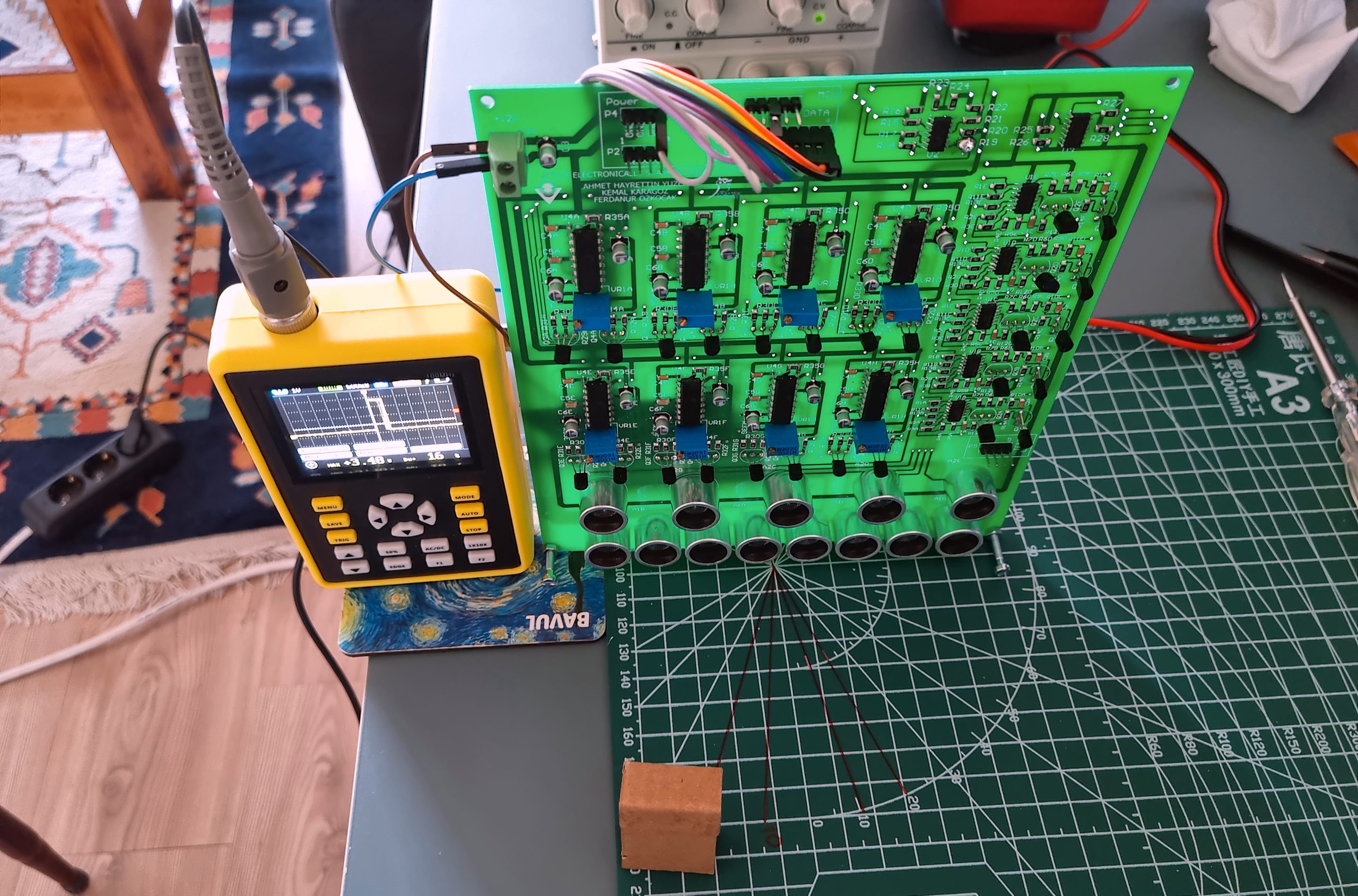
In 2024, I completed my undergraduate thesis on an Active Electronically Scanned Array Sonar system, a project that took approximately 1.5 years of research, design, development and experimentation.
What started as an idea inspired by phased-array radar technology (AESA Radar especially) gradually evolved into a working experimental prototype involving 40kHz ultrasonic transducers, custom analog electronics, signal generation, PCB design, mathematical modelling and embedded systems.
Although the final prototype was far from a fully developed sonar system, it provided valuable hands on experience. It introduced me to several engineering challenges that I am still interested in exploring today.
Looking back at the project I can now identify numerous design decisions, limitations, and potential improvements that I would approach differently with the knowledge and experience I have gained and improved technology tools like AI since then.
Rather than letting this project remain just an undergraduate thesis, I have decided to revisit it, document its development and gradually take it to the next level.
This blog series will cover the original design process, technical challanges, experiments, lessons learned and my plans for developing a more modular and spohisticated ultrasonic phased-array platform with a proper versioning by using git :D.
Also I have some adventages right now like having a regular salary and the experience I’ve gained. When I was a student my budget was very tight and I had to be extremely careful with how I spent my money :(. Things are a little different right now. I have more financial freedom to experiment, try new components, being able to invest in equipment that is a notch more expensive.
I am my own angel investor right now 😀
| Chapter | Phase | Content | Published | Planned |
|---|---|---|---|---|
| 01 | How I Built My First Phased-Array Sonar | The story begind the project, the 1.5 year development journey, initial objectives, challanges and results | ||
| 02 | Designin an Ultrasonic Transducer Array | 8 TX / 5 RX architecture, transducer spacing, wavelength calculations, array geometry and grating lobes | ||
| 03 | 40 kHz Signal Generation and Modulation | SG3525-based signal generation, ESP32 control, transmitter electronics and references to previous blog posts | ||
| 04 | Analog Receiver Circuit Design | TL084 operational amplifiers, signal amplification, filtering, clipping and challenges encountered during development | ||
| 05 | PCB Design and Manufacturing | Altium Designer or KiCAD, hierarchical schematic design, PCB layout, fabrication, assembly and troubleshooting | ||
| 06 | Beam Steering: Theory vs Experiments | Phase shifting, engineering review, architectural limitations, design mistakes, lessons learned and potential improvements | ||
| 07 | What I Would Do Differently Today | A retrospective engineering review, architectural limitations, design amistakes, lessons learned and potential improvements | ||
| 08 | Sonar V2: Development Roadmap | A modula system architecture, sychronized signal generation, redesigned transmitter drivers, improved receiver electronics and future development plans |
Tools, Software & Resources
Throughout this project, I used several tools for circuit design, simulation, mathematical modelling, PCB development and documentation.
Some of these tools were used during my original undergraduate project, while other are being considered for future development. I’ll keep this section updated as the project evolves.
Original Project (2023-2024)
| Category | Software & Tools |
|---|---|
| Schematic & PCB Design | Altium Designer, KiCad |
| Circuit Simulation | LTSpice, QSpice |
| Mathematical Modelling & Visualization | Python, NumPy, Matplotlib |
| Embedded Development | Arduino IDE, ESP32 |
| Technical Documentation | Component Datasheets, application notes, academic papers and technical books |
Future Development (Sonar V2)
| Category | Software & Tools |
|---|---|
| Schematic & PCB Design | Altium Designer, KiCad |
| Circuit Simulation | LTSpice, QSpice, Qucs-S (under consideration) |
| Mathematical Modelling & Visualization | Python, NumPy, Matplotlib, Wolfram Mathematica (under consideration) |
| Embedded Development | Arduino IDE, ESP32 |
| Technical Documentation | Component Datasheets, application notes, academic papers and technical books |
| Version Control | Git |
| Research & Reference Management | Zotero (planned) |
As I revisit the project, I’ll also share the technical references and resources that helped me understand different concepts and make design decisions.
What’s Next?
The first part of this series will focus on the origins of the project, the motivation behind it, and the journey from initial concept to experimental prototype.
As the series progresses, I will dive deeper into the technical aspects of the original system while also sharing new ideas, design considerations and experimental developments.
My goal is not simply to rebuild the original prototype with better components, but to approach the entire system with a more structured, modular and measurement-driven engineering methodology.
I also intend to document unsuccessful experiments, unexpected results and changes in design decisions along the way. After all, understanding why something does not work is often just as valuable as getting it to work.
This page will serve as the central index for the series and will be updated with lins as new articles are published.
Thanks for following along on my engineering journey!
Last updated: October 2026
~ Kemal Karagöz
